
Understanding Large Language Models (LLMs): How They Work and Why They Matter
What is a Large Language Model?
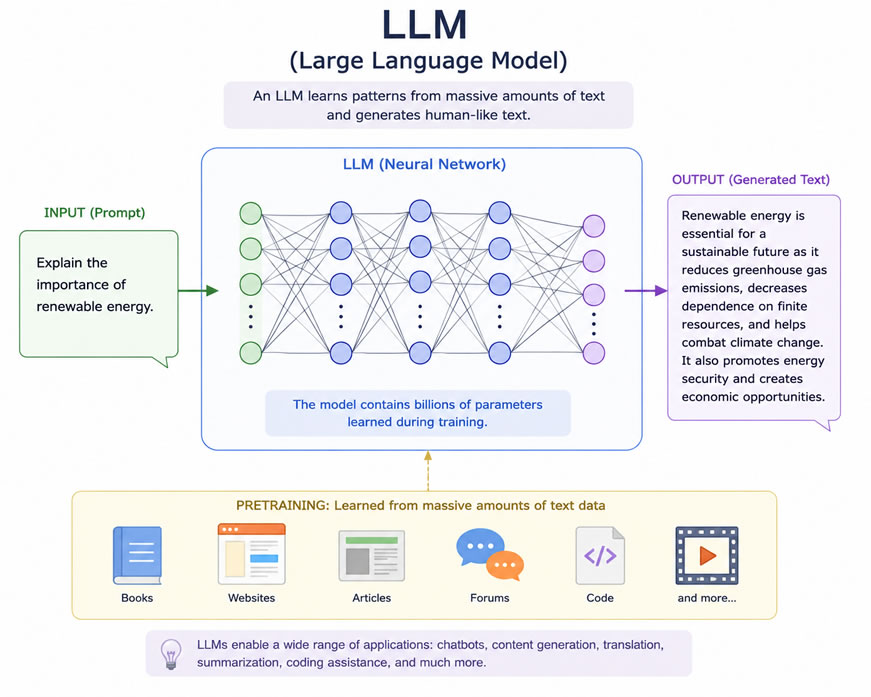
A Large Language Model is an advanced AI system trained on massive amounts of text data. Its primary goal is to understand and generate human-like language. By learning patterns, grammar, facts, and even reasoning from billions of words, LLMs can perform tasks such as:
1. Text generation: writing articles, stories, or code.
2. Translation: converting text between languages.
3. Summarization: condensing long documents into key points.
4. Question answering: providing direct answers from context.
Popular examples include GPT (OpenAI), PaLM (Google), and LLaMA (Meta).
How Do LLMs Work?
LLMs rely on a breakthrough AI design called the Transformer architecture. Here’s how the process unfolds:
1. Tokenization: Text is broken into small units called tokens (words, subwords, or characters).
2. Self-Attention Mechanism: The model evaluates relationships between words. For example, in the sentence “The animal didn’t cross the street because it was too tired,” the model learns that “it” refers to “the animal,” not “the street.”
3. Parameters: LLMs contain billions of adjustable weights that capture patterns in language. The more parameters, the more nuanced the model’s understanding.
4. Prediction: The model generates text by predicting the most likely next token, creating coherent sentences and paragraphs.
In conclusion, Large Language Models represent a revolutionary step in AI. By leveraging transformers and self-attention, they can process vast amounts of text and generate language that feels natural and intelligent. While challenges remain, their potential to transform communication, business, and research is undeniable.